Every software vendor that embeds reporting inherits a second job: teaching customers how to use it. You write the training, your support team answers the "how do I build a report?" tickets, and the self-service promise you sold turns back into requests for your developers.
The short answer: Yurbi now includes Getting Started, an in-product checklist with guided "Show me how" tours for each role. It carries your product name, your terms and your brand color, it has no links back to us unless you want them, and you switch it on or off per tenant through branding policies.
What Getting Started is
Getting Started is a short checklist that sits beside the user's work, with a guide for each role:
- Admins get "Set up your workspace": connect your data, build your app, set up security groups, create a first report and build a dashboard.
- Architects get "Model your data": open a data source, add tables and joins, organize and name fields, then test in the builder.
- Builders get "Build reports and dashboards": create a report, add a visualization, save it and put it on a dashboard.
- Agents, your view-only users, get "Find and use reports": run a report, use a dashboard, favorite what they use, and schedule or export.
Steps check themselves off when the user does the real work. Saving a report ticks the report step; a failed save ticks nothing. Progress is tracked per user, and anyone can mark a step done, skip it or undo it.
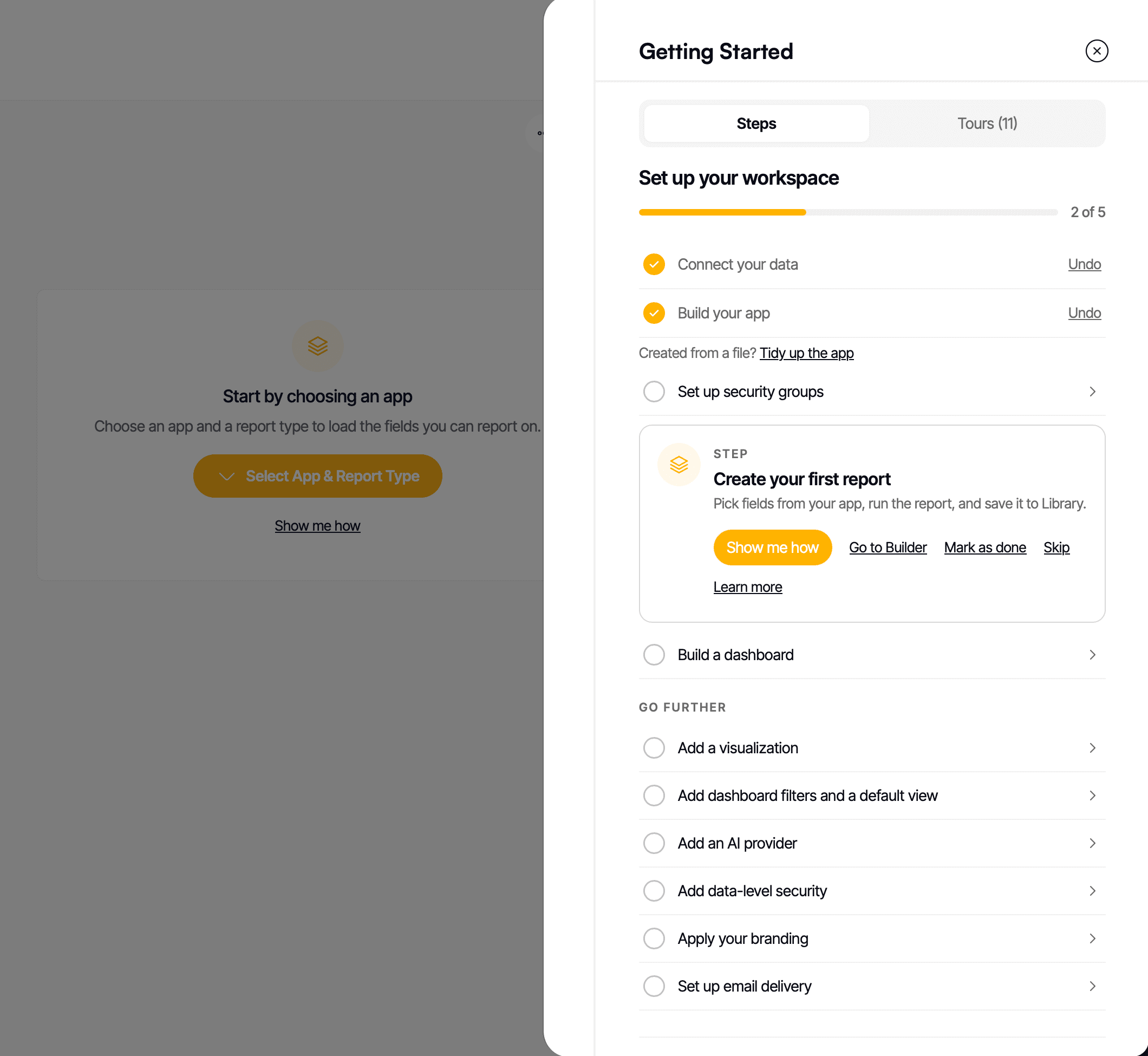
Each step has a Show me how button that starts a guided tour on the live screen. The tour points at the next control, waits while the user does it, and moves on. There are eleven tours today, from "Build your app" to "Schedule or export a report", and each user sees only the ones their role can complete. Empty screens help too: a blank library or dashboard page names the matching step and can start its tour.
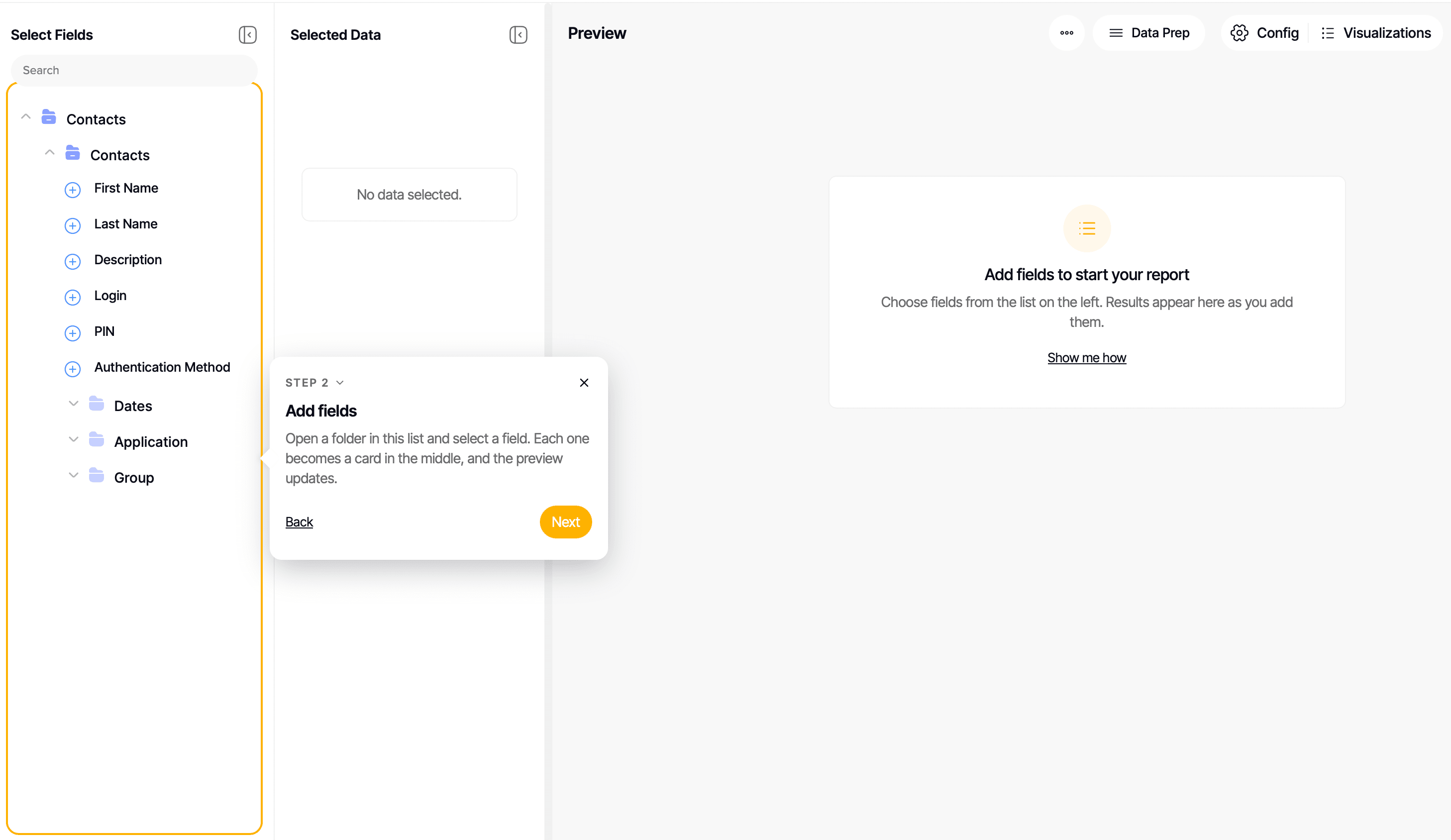
Built for white-label from the first line
An onboarding guide that says "Welcome to Yurbi" is no use inside your product. Getting Started was written so that it never has to:
- Your product name and terms. Nothing in the guide hardcodes our name. Step and tour text uses the product name you set and the terms you use for the library, the builder and reports.
- Your brand color. Buttons, the progress bar, the active tab and the tour highlight all take the primary color from your branding policy.
- No links back to us. Learn more links to our implementation guide show only while a system carries the stock product name. Rename the product and they disappear. Each branding policy also has a "Show Learn more links in Getting Started" switch, and we recommend turning it off for customer-facing policies.
- Invisible in embeds. Getting Started never appears on embedded or framed pages or to guest users, so nothing pops up inside the dashboards you embed in your own application.
Turn it on for some tenants and not others
This is the part that matters most for multi-tenant products. Getting Started is a setting on every branding policy, and policies are assigned per tenant or user group. Each policy chooses one of four options:
- Full: a welcome card at first sign-in, a Getting Started item in the main menu with progress, and a reminder of the next step.
- Quiet: nothing opens by itself. The guide and tours are there in the profile menu for users who go looking.
- Off: no guide, no tours, no menu entries.
- Auto: follow the server's default.
That gives you real segmentation. Show the full guide to tenants on a plan that includes self-service report building. Keep it quiet for long-standing customers who already know the product. Switch it off for tenants whose users only view embedded dashboards.
Upgrades stay quiet
When you upgrade a server that is already in use, Getting Started arrives in Quiet mode. Your customers don't see a welcome card they didn't ask for. The server default is decided once and kept, and an administrator can change it in Server Settings at any time.
A brand-new server is different: with no users or apps yet, it starts in Full mode so the first administrator gets the welcome card. If you provision a new server for each customer, set the mode on your branding policy before you hand it over.
Setting it up for your product
- Set your product name and brand color in your branding policy.
- Turn off "Show Learn more links in Getting Started" on every customer-facing policy.
- Choose Full, Quiet or Off for each policy, by tenant or audience.
- Sign in as a test user in each role and run a tour, so you see exactly what your customers will see.
It helps your own team first
Before your customers see any of it, your team does. The admin and architect guides walk a new Yurbi install from an empty workspace to a first dashboard: connect a database, model it into an app, and test it in the builder. If you're evaluating Yurbi or starting your integration, that's the shortest path to something you can demo internally.
If you use Yurbi's AI features, the admin guide also covers them: "Add an AI provider", then "Turn AI on for an app" to choose which apps people can ask questions about.
What's next
Getting Started is a foundation we'll keep building on:
- More tours and more "Show me how" steps, starting with connecting data, inviting users and security groups.
- More lessons behind the Learn more links.
- Translations. The guide text is in English today. Support for your own phrase translations is on the roadmap.
Try it
- Already a customer? Upgrade to the latest release, then open Getting Started from the profile menu.
- Start a free trial and let the admin guide take you from install to first dashboard.
- Prefer a walkthrough? Book a demo and we'll show it running under a custom brand.
Frequently asked questions
Is Yurbi's Getting Started onboarding white-label safe?
Yes. Getting Started uses the product name and terms you have set, and its buttons, progress bar and tour highlights follow your branding policy's primary color. Learn more links to Yurbi's own guides are hidden by default on any system that doesn't carry the stock product name, and each branding policy has a switch for them.
Can I turn onboarding on for some tenants and not others?
Yes. Every branding policy has its own Getting Started setting: Auto, Full, Quiet or Off. Because policies are assigned per tenant or user group, you can show the full guide to tenants who build their own reports and switch it off for view-only tenants.
Does Getting Started appear inside embedded dashboards?
No. It never shows on embedded or framed pages, or to guest users. It appears only when a user works in the full Yurbi interface.
What happens to Getting Started when I upgrade an existing Yurbi server?
A server that is already in use starts in Quiet mode. No welcome card opens and nothing is added to the main menu. The guide and tours stay available from the profile menu until an administrator chooses Full.
Is the Getting Started text available in other languages?
The guide and tour text is in English today. Support for your own phrase translations is on the roadmap.

Stop rebuilding your reporting layer.
Embed Yurbi into your product and ship analytics to your customers in weeks — not quarters. Self-hosted, white-labeled, flat annual pricing.
Download Free Trial See a Live DemoStartup or small software vendor? Ask about startup pricing →